AI is not destroying the future of work. It is collapsing it. Distinct career paths and long-term professional timelines are compressing into a single moment of "now," and the professionals who recognize this shift will define the next decade of enterprise leadership.
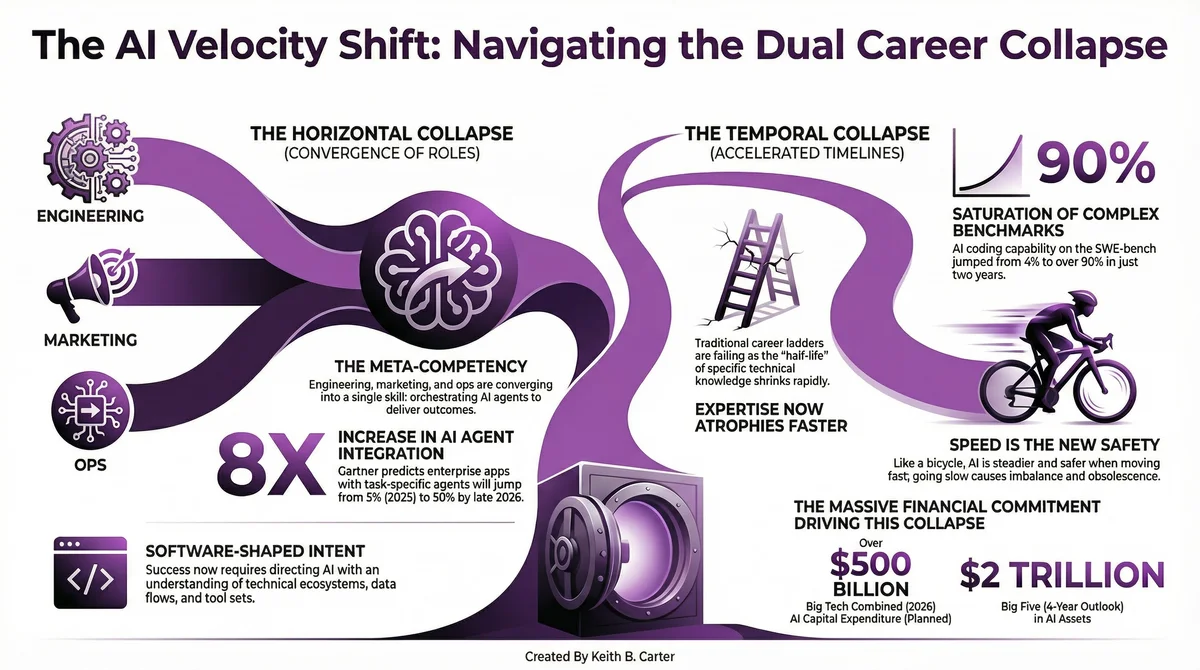
The Great Compression is the defining structural transformation of the 2020s. It operates across two dimensions simultaneously: a horizontal collapse of functional roles and a temporal collapse of career leverage. Together, these forces are converting the entire professional landscape into variations on a single theme. Humans directing AI.
The Horizontal Collapse: When Every Role Becomes One Role
Engineering, marketing, product management, operations, and analytics once occupied distinct professional territories. Each required years of specialized training. Each followed its own career ladder. Each produced its own type of organizational value.
That architecture is disintegrating.
AI agent orchestration is replacing functional specialization as the primary differentiator in enterprise value creation. What used to be 50 different specializations is converging into variations on a single capability.
The evidence is already visible in production environments. Product managers who once synthesized customer feedback and manually drafted specifications are now prompting models to draft specs and using agents to build directly in production. The role is no longer defined by manual coordination. It is defined by the high-level direction of autonomous workflows.
Functional Impacts Across the Enterprise
The horizontal collapse is not limited to technology teams. Every function that touches a screen is experiencing convergence:
- Legal: Contract review cycles that required weeks of manual labor now compress into hours of agent-mediated oversight
- Finance: Tools like Claude in Excel build complex projections in minutes, fundamentally altering time-to-value for financial modeling
- Customer Success: Agents handle 80% to 95% of initial inquiries, necessitating a total redesign of human staffing models
- HR: Recruitment screening, onboarding documentation, and policy compliance are increasingly orchestrated through agent pipelines
Each of these functions is collapsing toward the same center of gravity. The ability to direct AI agents with precision and intent.
The Stranded Asset Problem
Leadership must confront a stark economic reality. Domain expertise becomes a "stranded asset" if it is not liquidated and reinvested into AI orchestration. The value of 10 to 15 years of experience in design, finance, or engineering will largely evaporate by late 2026 if it is not coupled with the ability to direct AI.
Expertise is no longer a standalone differentiator. It is the raw material used to inform software-shaped intent.
This is not a prediction about job elimination. It is a prediction about value transfer. The knowledge itself retains utility, but only when channeled through agent orchestration. A veteran finance professional who can direct AI agents to build models, stress-test assumptions, and generate board-ready reports in an afternoon will outperform a team of five analysts working manually. The expertise is the same. The delivery mechanism is entirely different.
The Temporal Collapse: Five-Year Plans in Five Months
The second dimension of the Great Compression attacks the timeline itself. The traditional career model followed a predictable arc: learn a skill, practice for two to three years, earn a promotion, compound your advantage over decades. That model assumed expertise was an appreciating asset.
It is now a depreciating one.
The half-life of specific AI knowledge is short and shrinking. The half-life of the habit of learning AI is long and durable. This distinction defines who thrives.
The SWE-bench coding benchmark illustrates the acceleration. AI coding capability jumped from solving 4% of problems in 2023 to over 90% saturation by 2025. The critical insight is not that it reached 90%. It is that the doubling time to get there shrank with each cycle. The curve is steepening, not flattening.
The Career Ladder Is Broken
The traditional promotion cycle of two to three years is collapsing into a cycle of months. Professionals who planned to build leverage over a five-year horizon must capture that leverage now. The appreciation model, where you learn a skill once and it compounds into career stability, has been replaced by a depreciation model where skills atrophy rapidly and continuous updating is mandatory.
This is the orchestration era. The annual doubling rate of AI improvement has rendered five-year strategic planning obsolete. Organizations and individuals who operate on legacy timelines are not being cautious. They are falling behind an exponential curve with no plateau in sight.
The Mechanism of Collapse: The Agent Explosion
The mechanism driving both dimensions of compression is the rapid deployment of AI agents across enterprise software. Gartner predicts task-specific AI agents will be integrated into nearly 50% of enterprise applications by late 2026. That represents an eight-fold increase from the less than 5% seen in 2025.
This is not a gradual transition. It is a phase change.
Already, 57% of companies have AI agents in production as of 2025. The transition from "experiment" to "standard" is happening in quarters, not years. Specific domain expertise is now mediated through these universal agents, and the professionals who understand how to orchestrate multi-agent teams hold a compounding advantage over those still executing tasks manually.
The Financial Inevitability
The infrastructure supporting this collapse is backed by the largest capital expenditure project in human history. Amazon, Microsoft, Google, Meta, and Oracle are targeting a combined $2 trillion in AI-related assets over the next four years. Over $500 billion in Big Tech AI capital expenditure is planned for 2026 alone.
There is no bubble to wait out. The infrastructure is being cemented. The only way forward is through AI.
This scale of investment ensures that the agentic future is non-negotiable. Organizations hoping the technology will "cool off" or that they can skip this cycle are miscalculating the permanence of the shift. The compute infrastructure, model capabilities, and enterprise tooling are all converging toward a world where agent orchestration is the default operating model.
Software-Shaped Intent: The New Required Skill
To survive the Great Compression, every professional whose work touches a computer screen must develop what I call "software-shaped intent." This is the ability to direct agents within the constraints of a technical ecosystem. You do not need to be a software engineer. You must know how to structure a request so a machine can execute it.
Software-shaped intent requires synchronizing three pillars when directing AI agents:
- Toolset: Does the agent have the specific computational tools required to execute the mandate?
- Memory: How is the agent accessing, retaining, and synthesizing the necessary context and historical data?
- I/O: Is the output "software-shaped," meaning readable and writable data that downstream systems can consume?
When leaders view business problems through the lens of data interaction, they solve problems with unprecedented efficiency. This is not a technical skill in the traditional sense. It is a cognitive shift. The future of work belongs to humans directing AI with deep knowledge and precise software-shaped intent toward a defined outcome.
Non-technical functions, from HR to Finance to Legal, must adopt the mindset of a software architect. When you direct agents, you are essentially architecting data interactions to solve business problems. The KDA framework, Know-Decide-Act, provides the structure for this transition: Know the agent's capabilities and constraints, Decide the optimal workflow architecture, and Act by deploying agents toward measurable outcomes.
The Velocity Paradox: Why Going Faster Is Safer
The counterintuitive truth at the heart of the Great Compression is that speed creates stability. Like a bicycle that wobbles when moving slowly and stabilizes at speed, AI adoption follows the same physics.
- Intuition says: Going slower feels safer. You have time to think, brake, and adjust.
- Reality shows: Going slower causes instability and wobbling. You lose momentum and balance.
- AI reality confirms: Speed creates steadiness. Continuous engagement builds the compound learning that transforms confusion into competence.
Organizations that wait for the technology to "stabilize" will lose the advantage of compound learning to early adopters who are already establishing the norms of 2027. You cannot catch up to compound interest. While you wait for stability, early adopters are building workflows, capturing opportunities, and setting industry standards. They have two years of compound learning. That gap is unbridgeable.
You cannot learn to swim from a deck chair. You must get on the bike and pedal fast to find your balance.
The old career model treated expertise as an appreciating asset. Learn a skill, watch it compound, enjoy career stability. The new model demands continuous reinvestment. Skills atrophy rapidly. The only durable asset is the learning habit itself, the muscle memory of engaging with new tools, experimenting with agent configurations, and adapting workflows in real time.
The Decision: Engage or Leave the Screen
For any professional whose work touches a computer screen, the choice is binary. Lean in with curiosity, or face accelerating irrelevance. There is no middle path. There is no "wait and see" that preserves your position.
The only true opt-out is a total career change to work that does not involve a screen. Carpentry. Manual trades. Physical craftsmanship. For everyone else, the screen is now an AI interface, and resisting that reality while continuing to sit in front of it leads to professional misery.
Choosing to engage with curiosity leads to empowerment. The professionals who thrive through the Great Compression will share three habits:
- Lean in today. Try a new AI tool. Experiment with agent orchestration. Stop waiting for permission.
- Trust the pattern. Your unconscious brain will learn the "software shape" of AI if you give it enough repetitions. Fluency comes from practice, not preparation.
- Pedal faster. Increase your experimentation rate to find stability. The learning compounds. Each week of active engagement creates advantages that non-participants cannot replicate.
We did not choose this timeline. But we must live in it. The Great Compression is not a threat to be managed. It is a density to be navigated, and the professionals who move fastest through it will emerge with capabilities that define the next era of enterprise leadership.
Going faster is safer and less scary with AI than going slower. The only question is whether you will discover that truth now, or after the compound cost of waiting has already determined your trajectory.
Want to put this into practice?
Keith works with leadership teams across Asia and globally to turn AI insight into action. Reach out directly — response within 24 hours.