The era of the "Lone Coder" is ending.
We are witnessing the birth of the Orchestration Layer. The blinking cursor of a single IDE is giving way to a digital department operating in synchronized precision.
When you activate the latest experimental features in tools like Claude Code, your terminal does not just run a script. It erupts into a split-pane symphony of activity. On the left, a Lead Agent directs the flow. On the right, multiple specialized agents (security reviewers, documentation experts, backend engineers) fire off commands in parallel.
This is not a multi-window UI gimmick. It is a fundamental shift toward Autonomous Engineering. Sophisticated agent teams now collaborate, communicate, and solve problems that would break even the most advanced single-model LLM.
The implications for enterprise technology strategy are enormous. The leaders who understand the architecture of these systems will be the ones who capture the value.
Collaboration vs. Isolation: The Context Revolution
To appreciate why agent teams represent a paradigm shift, you must understand how they differ from the sub-agents we have used for the past two years.
In the world of large language models, context is the most precious resource. How we manage it determines the success of the build.
Sub-agents: The Black Box
A primary agent hands off a task, receives a condensed summary, and the sub-agent's internal context is discarded. If you have two sub-agents running simultaneously, they are effectively blind to each other's existence.
There is no coordination. This is the "black box" model. Useful for research. Unreliable for implementation.
Agent Teams: Peer-to-Peer Coordination
In an agent team, every agent works from a shared, dynamic task list. A backend agent can ping a frontend agent in real-time to signal an API schema change, preventing the "broken implementation" cycle that plagues isolated agents.
Every member of the digital department is working toward the same evolving blueprint.
The unlock is not a smarter model. It is a smarter system. One where context flows between agents the way information flows between the best-run engineering teams.
This distinction is not academic. It is the difference between an AI that produces a code snippet and an AI that ships a working product.
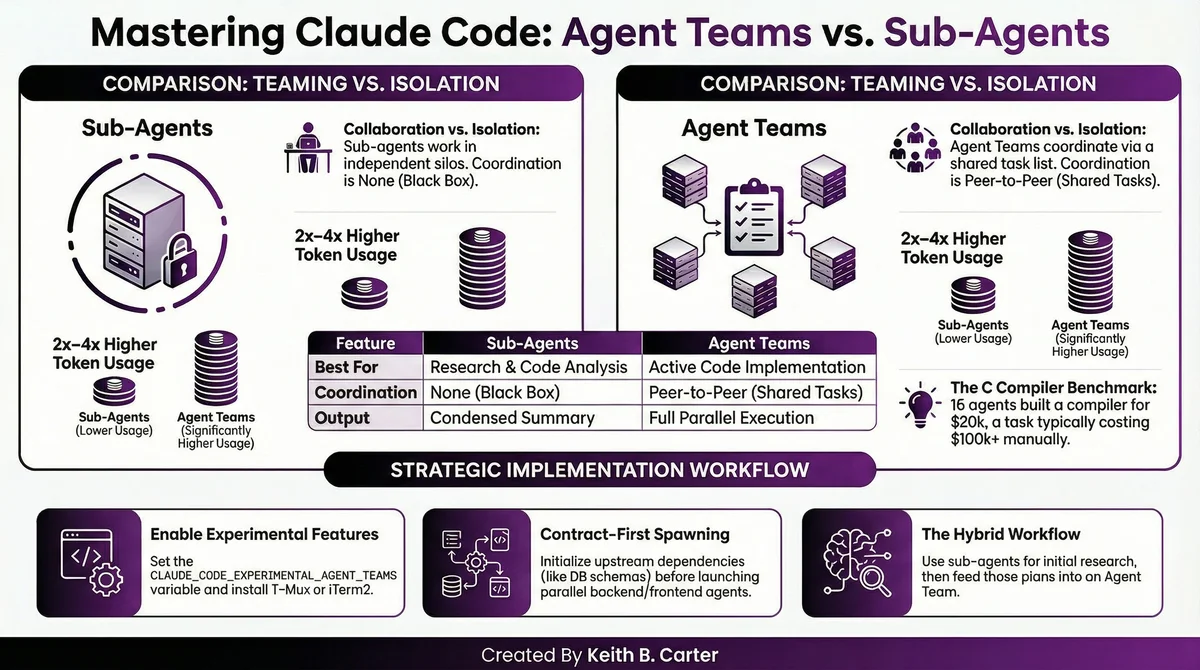
The $20,000 C Compiler: Proof of System Architecture
The power of multi-agent orchestration was recently proven when a team of 16 agents successfully built a C compiler from scratch.
This is a monumental task. It would typically require a dedicated human engineering team and a budget in the hundreds of thousands of dollars.
The agent team achieved it for roughly $20,000 in API costs.
The true takeaway is not the price tag. It is the architecture.
A single agent, even the most capable model available, would have failed this task. The context window is too small. The complexity is too high. The unlock was the Read-Act loop and the collaborative system that allowed 16 agents to autonomously generate hundreds of thousands of lines of working code.
Each agent held a piece of the puzzle. Together, they assembled something none could have built alone.
The KDA Framework Applied to Agentic Systems
This is the core insight when we apply the Know-Decide-Act framework to agent orchestration:
- Know the architecture. Understand what each agent can and cannot do.
- Decide the orchestration strategy. Determine which agents run first, which run in parallel, and how context flows.
- Act on the implementation with disciplined execution.
The teams that skip the Know and Decide phases, that simply launch 16 agents and hope for the best, will burn tokens and get garbage.
The Infrastructure of the Agentic Mind
To make these digital departments visible to the human orchestrator, you need the right infrastructure.
Seeing agents work in split-pane mode requires terminal applications that support high-level multiplexing. Specifically T-Mux or iTerm 2. Windows users will require WSL to leverage T-Mux effectively.
The activation path is a single environment variable:
CLAUDE_CODE_EXPERIMENTAL_AGENT_TEAMS=true
Once active, the Lead Agent acts as the conductor. It analyzes your request, defines the team structure, and spins up the necessary terminals.
The feature is raw. Visibility remains a challenge, and you must watch the logs closely to see agents communicating. Use Ctrl+B followed by arrow keys to navigate between T-Mux panes and interrogate individual agents on their progress.
This operational detail matters for enterprise leaders. The tooling is experimental today, but the architecture is production-grade. The organizations building internal competency on these systems now will have a decisive advantage when they reach general availability.
Contract-First Spawning: Human Guardrails for AI Chaos
While native agent team functionality is a massive leap forward, it is still experimental and imperfect.
Left unconstrained, multi-agent systems can suffer from race conditions. A backend agent finishes its work based on a database schema that has not been finalized by the database agent. The result: expensive rework and wasted tokens.
Veteran practitioners have engineered a solution: the Contract-First Spawning strategy.
Instead of letting all 16 agents run simultaneously without coordination, the Lead Agent follows a human-engineered template:
-
Upstream logic first. The database agent spawns first and establishes a schema. This is the "contract" that all other agents will build against.
-
Parallel execution second. Only once the contract is shared and validated do the downstream backend and frontend agents spawn.
This is a direct application of the Decide phase in the KDA framework. The strategic decision about agent sequencing is not a technical detail. It is the difference between a successful build and a $5,000 hallucination.
The contract-first approach mimics the workflow of high-performing human engineering teams: establish the interface contracts, then build in parallel against them.
The organizations that treat agent orchestration as a strategic discipline, not just a technical experiment, will outperform those that treat it as a feature toggle.
The Token Tax: Understanding the Economics of Autonomy
Autonomy is not free.
Agent teams are token-heavy by nature, requiring constant communication overhead to maintain the shared task list and peer-to-peer coordination. You can expect agent teams to cost 2 to 4 times more than standard single-agent usage.
This is where strategic thinking separates the leaders from the experimenters.
The Rule of Thumb
-
Use sub-agents for research and analysis. If you need a summary of a codebase, a competitive analysis, or a data extraction task, do not pay the collaboration tax. Sub-agents are efficient, isolated, and cost-effective for information retrieval.
-
Use agent teams for implementation. When the code must handshake across different layers of the stack, when the frontend, backend, and database must all agree on a schema, the coordination overhead is worth every token.
The Financial Discipline
The contract-first strategy described above is not just an accuracy tool. It is a financial discipline designed to make the token tax worth the price by eliminating redundant rework.
Every race condition avoided is money saved. Every clean first-pass implementation is a sprint cycle recovered.
For enterprise budget holders, the math is straightforward: a 16-agent team that builds a compiler for $20,000 versus a human team that builds one for $200,000 represents a 10x cost reduction. That holds even after accounting for the 2-4x token premium over single-agent usage.
From Coder to Orchestrator: The Career Transformation
The trajectory is clear.
The role of the human developer is evolving from someone who writes syntax to someone who validates intent. You are no longer just a coder. You are the Director of Intelligence, managing a high-output digital department.
This transformation applies at every level of the enterprise:
-
Individual contributors must learn to think in terms of agent composition, not code completion. The skill is orchestration, not syntax.
-
Engineering managers must learn to estimate and budget for agent team operations. Token economics are now a line item, not an abstraction.
-
C-suite leaders must understand that the competitive moat is shifting. It is no longer "we have the best developers." It is "we have the best orchestration systems."
The KDA Strategic Scaffolding
The KDA framework provides the roadmap:
- Know the capabilities and limitations of each agent type.
- Decide the orchestration architecture. Choose contract-first pipelines, hybrid research-to-implementation workflows, and cost guardrails.
- Act with disciplined execution. Measure token economics against outcomes and iterate on the system.
The Strategic Imperative
We are in the experimental phase of this technology. The features are behind flags. The tooling is rough. The documentation is sparse.
None of that matters.
The organizations that invest in understanding multi-agent orchestration today, that build the internal skills, the cost models, the contract-first playbooks, will be the ones that dominate when these systems reach production maturity.
The gap between "experimenting with AI" and "orchestrating AI at scale" is widening every quarter.
The question is no longer whether AI can code. The question is: are you building writers of syntax, or directors of intelligence?
Ready to build your organization's agent orchestration capability? Explore the AI Masterclass Series for hands-on training, or learn how the KDA Decision Engine provides the strategic framework for AI-driven decision-making.
Want to put this into practice?
Keith works with leadership teams across Asia and globally to turn AI insight into action. Reach out directly — response within 24 hours.