Working memory holds four to seven items at any given moment. Cognitive science has confirmed this limit repeatedly across decades of research. That constraint is the reason phone numbers are the length they are. It is also the reason your mental bandwidth feels perpetually maxed out in a world that demands you track hundreds of open threads simultaneously.
Every time you tell yourself "don't forget to follow up on that email," you are running a background process that drains your system. This cognitive tax manifests as persistent, low-grade anxiety. Open loops hum in the background of every meeting, every conversation, every attempt at deep work. The tax is invisible, but the cost is real: relationships cool because you forget what mattered to your partner, projects fail because a critical late-night insight evaporated by morning.
2026 is the year this changes. We finally have the tools to separate memory from compute, and the leaders who build these systems first will compound an advantage that grows every single day.
Your Brain Is a Processor, Not a Filing Cabinet
Forcing the brain to act as a storage device is a structural error. Every unit of energy spent trying to remember a detail is energy stolen from your ability to think a new thought, solve a problem, or engage deeply with another person.
Brains are designed to think. Every time you force a brain to remember something instead of letting it think of something new, you are paying a tax you do not see.
Traditional productivity systems have failed because they act as workarounds rather than integrated solutions. They require "taxonomy work" at the exact moment you are most distracted. They ask you to tag, file, and organize when you are walking into a meeting or trying to go to sleep. The result is predictable: these systems collapse into dead information dumps. The corporate wiki that no one trusts. The Evernote account that became a digital graveyard.
The Know-Decide-Act framework provides a better lens. Know what your brain is good at (pattern recognition, creative synthesis, relationship building). Decide to stop forcing it to do what it is bad at (reliable storage, retrieval on demand). Act by building an external system that handles the storage layer while your brain handles the thinking layer.
The Shift from Passive Storage to Active AI Loops
The failure of the note-taking era (Evernote, Obsidian, early Notion) was passivity. These were static dumps of old information. You captured a thought, manually decided on a folder, added tags, and hoped you would remember to search for it six months later. The system was a "company wiki" that eventually died from neglect.
In 2026, the paradigm has shifted to AI Loops, where the center of gravity moves from the human to the automation.
The old way (storage): You take a note. You manually decide on a folder. You add tags. You hope you remember to search for it. The system is static. It dies from neglect.
The new way (loops): You capture a thought in seconds. The system classifies, routes, and structures that data while you sleep. It nudges you with the information exactly when you need it.
This follows a core systems design principle: separate memory from compute and interface. Your memory layer (Notion, a database) stays separate from your logic layer (Claude, an LLM) and your interface layer (Slack, email, or a CLI). Each component can be upgraded, replaced, or repaired without breaking the others.
Building a Second Brain with Claude Code
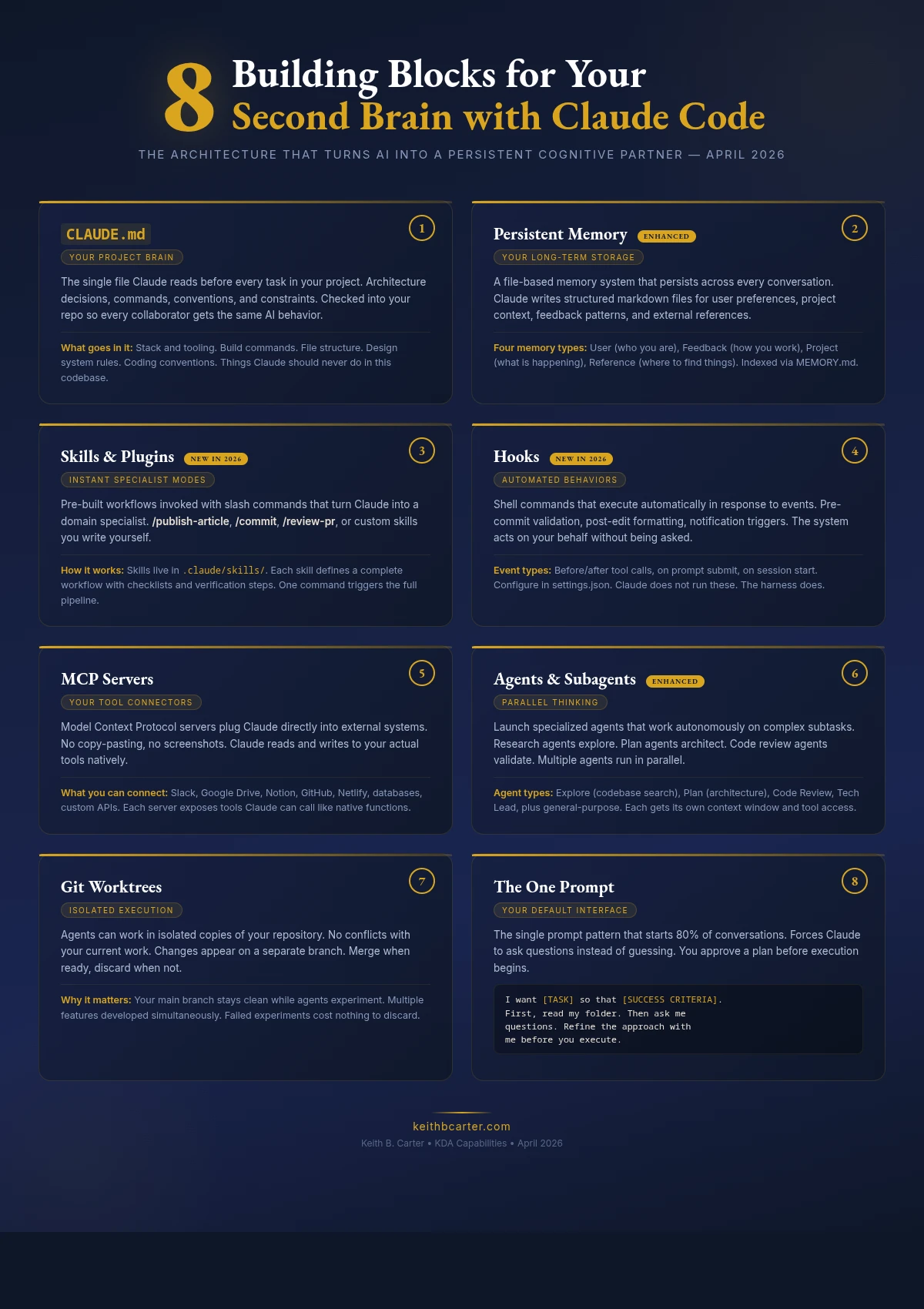
The infographic below illustrates eight files that transform Claude Code from a generic AI assistant into a persistent cognitive partner. This is not theoretical. This is a working architecture.
The Identity Layer
about-me.md tells Claude who you are before every task. Your background, your job, your current priorities. This is not vanity. It is calibration. A senior technology strategist gets different outputs than a first-year analyst, even when both ask the same question. What matters to you this quarter. Decisions you have already made. This file prevents Claude from relitigating settled questions.
voice-profile.md captures how you think, write, and see the world. Created through a structured interview process, it encodes your beliefs, your contrarian takes, your writing mechanics (sentence structure, rhythm), and your aesthetic boundaries (what makes you cringe, what you would never write). This is your taste DNA in machine-readable form.
anti-ai-writing-style.md defines your boundaries. Words you ban. Structures you reject. Tones you hate. Taste is what you reject, and this file ensures Claude never sounds like a generic AI when writing as you.
The Knowledge Layer
The Cowork Folder is a four-folder system on your computer that Claude reads directly. Three read-only folders, one write folder. Everything Claude needs, nothing it does not.
- ABOUT ME/ contains your identity and writing rules
- PROJECTS/ holds one subfolder per project with briefs, drafts, and references
- TEMPLATES/ stores finished work you reuse as patterns
- CLAUDE OUTPUTS/ is the only place Claude delivers work
This architecture is powerful because it is simple. No database. No API. Just folders and files that both humans and AI can read natively.
The Execution Layer
Global Instructions are persistent rules Claude follows every single time, before every task. Set once. They run forever. You never type them again. "Always read ABOUT ME/ before starting. Always read the matching PROJECTS/ subfolder. Study TEMPLATES/ before creating anything new. Only deliver work in CLAUDE OUTPUTS/."
The One Prompt is the single prompt that starts 80% of your conversations. It forces Claude to ask you questions instead of guessing wrong:
I want [TASK] so that [SUCCESS CRITERIA]. First, read my folder. Then ask me questions. Refine the approach with me before you execute.
This inverts the typical AI interaction. Instead of prompting and praying, you get a clickable form. You approve. Claude executes. If something is off, you interrupt. Claude recalibrates.
Connectors plug Claude directly into your existing tools. Slack, Google Drive, Notion, Gmail, Calendar, Figma, and 50+ others. No copy-pasting. No screenshots. Claude reads your actual tools.
Plugins are pre-built workflows that turn Claude into a specialist for your exact job. Marketing teams get voice-matched content drafting. Data teams get CSV exploration and dashboard building. Sales teams get account research and outreach drafting. Install in one click. Each comes with its own slash commands.
The Dropbox Principle: Friction Is the Enemy of Memory
A successful second brain requires a single, frictionless capture point. In systems engineering, the Dropbox principle states that if capture takes more than a few seconds, it will not happen.
In the 2026 stack, this capture point might be a private Slack channel, a quick-entry mobile app, or Claude Code's own memory system. The architecture relies on one core principle: reduce the human's job to one reliable behavior. That behavior is simple. One message per thought. No organizing. No tagging. You should never make a "taxonomy decision" at the moment of capture. Capture must be a reflex, not a project.
Claude Code implements this natively. When you encounter an important insight, a project decision, or a user preference, the system writes it to a persistent memory file automatically. No folders to choose. No tags to apply. The intelligence layer handles classification after the fact.
The Intelligence Layer: Sorting Without the Work
In 2026, classification is a solved problem. LLMs treat prompts like APIs, using structured JSON outputs to ensure reliability. Once a thought hits the capture point, the system routes it into a specific schema.
Four stable buckets handle most professional knowledge:
- People: Name, context (how you met), follow-ups, timestamp. Every person in your network becomes a living record that surfaces before your next meeting with them.
- Projects: Name, status (Active, Waiting, Blocked, Done), and the next action. Not the full project plan. Just the single next thing that moves it forward.
- Ideas: Title, one-liner (the core insight), and elaboration. The midnight breakthrough that used to vanish by morning now persists and compounds.
- Admin: Task name, due date, status. The operational debris that clutters working memory gets externalized immediately.
By focusing on the next action as the unit of execution, the system turns vague intentions into operational reality without the user ever opening a database.
Building Trust with Bouncers and Receipts
You do not abandon systems because they are imperfect. You abandon them because their errors are mysterious. To maintain trust, your architecture needs an audit trail.
You do not abandon systems because they are imperfect. You abandon them because you stop trusting them.
Trust is engineered through two mechanisms:
The Receipt (Inbox Log). A master database that records every capture, showing the raw text, its destination, and a confidence score. Full transparency. Every decision the AI made is visible and reversible.
The Bouncer (Confidence Filter). If the AI's classification confidence score falls below a threshold, the Bouncer prevents the data from polluting your main databases. Instead, it asks for clarification: "I am not sure where this goes. Can you repost with a prefix like 'person:' or 'project:'?" This keeps your second brain from becoming a junk drawer.
Claude Code implements a version of this pattern through its memory system. When confidence is high, information routes directly to the appropriate memory file. When context is ambiguous, it asks before storing. The system earns trust by being transparent about its own uncertainty.
Replacing Search with Nudges
Humans are historically poor at retrieval. We rarely think to search our notes before a meeting. We are excellent, however, at responding to what is placed in front of us. This is the difference between pull-based systems (you search) and push-based systems (the system surfaces).
A well-architected second brain uses proactive surfacing:
The Daily Digest. A small, actionable summary pushed to you each morning. Top three actions for execution. One stagnant project you have been avoiding. A reminder of recent progress. Under 150 words. Enough to orient your day without becoming another inbox to dread.
The Weekly Review. A Sunday summary identifying recurring themes, your biggest open loops, and three suggested actions for the coming week. This replaces the manual weekly review that most professionals skip after the second week.
These nudges ensure the system is alive. They provide a breadcrumb of value every day. The moment you stop getting value from a system, you stop using it. Proactive surfacing prevents that decay.
Design for Restart, Not Perfection
The "backlog monster" kills most productivity systems. Miss a week and the maintenance mountain becomes so intimidating that you never restart. This is a design flaw, not a discipline failure.
Build for restart, not for streaks. The operating manual is simple: do not catch up. Do a 10-minute brain dump into the inbox and resume. The system picks up where you left off because the AI handles the sorting backlog, not you.
Systems must also be easy to repair. If the AI files a thought incorrectly, provide a feedback handle. Reply to the message with "fix: this should be a person, not a project" and the automation updates the record instantly. When corrections are trivial, engagement stays high.
Claude Code's file-based memory architecture embodies this principle. Memory files are plain markdown. You can read them, edit them, or delete them with standard tools. There is no proprietary database to corrupt, no sync service to break, no migration to run. If something goes wrong, you open the file and fix it. The system is as repairable as a text document because it is a text document.
The Compounding Advantage
Building a second brain provides a profound shift in how you operate. By closing the loops that cause background anxiety, your head gets clearer. You show up with more continuity for your projects and your relationships. You move from a state of mental leakage to a state of compounding advantage, where every insight captured today becomes a building block for tomorrow.
The leaders who build these systems in 2026 will not just be more productive. They will be more present, more creative, and more reliable. The cognitive tax they eliminate compounds into an advantage that grows every single day.
The tools exist. The architectures are proven. The only question remaining is whether you will build the support system your mind needs, or continue paying the invisible tax on every thought you try to hold.
If you do not build a support system for your mind this year, what is the total cost of the ideas, opportunities, and relationships you will lose simply because you tried to remember them yourself?
Ready to build your own AI-powered operating system? Explore The Augmented Executive program to see how enterprise leaders are integrating AI into their daily decision-making workflows.
Want to put this into practice?
Keith works with leadership teams across Asia and globally to turn AI insight into action. Reach out directly — response within 24 hours.