The moment of truth is where your product promise meets your customer's reality. In financial services, these decisive interactions happen constantly: when a customer calls during a crisis, when a verification fails, when fees are disclosed, when a claim is processed. These are not routine transactions. They are the interactions that determine whether a customer stays for life or leaves forever.
Most financial institutions invest heavily in marketing promises. Fewer invest in the operational infrastructure required to deliver on those promises under pressure. The gap between what you say and what you do becomes visible at the moment of truth, and customers remember.
The Anatomy of a Moment of Truth
Every moment of truth contains three elements that define the outcome.
The Pressure Point. A situation where stakes are high and the easy path conflicts with the right path. The customer is in crisis. The colleague is in competition. The decision carries real cost. This is not a scripted interaction. It is a test of character that no amount of marketing can fabricate.
The Character Reveal. Your response at this pressure point reveals your true priorities. Not your marketing copy. Not your mission statement on the wall. Your actual values under stress. What you do when it costs you something is what defines your organization.
The Lasting Impact. The outcome of that single interaction shapes loyalty, trust, and reputation far beyond the moment itself. One interaction creates a lifetime customer. One failure creates a permanent critic. The compounding effect of moments of truth is what builds or destroys brands over decades.
The moment of truth is the interaction where what you promise meets what you deliver, under pressure. Organizations that understand this invest in operational capability, not just marketing language.
Moments of Truth in Your Organization
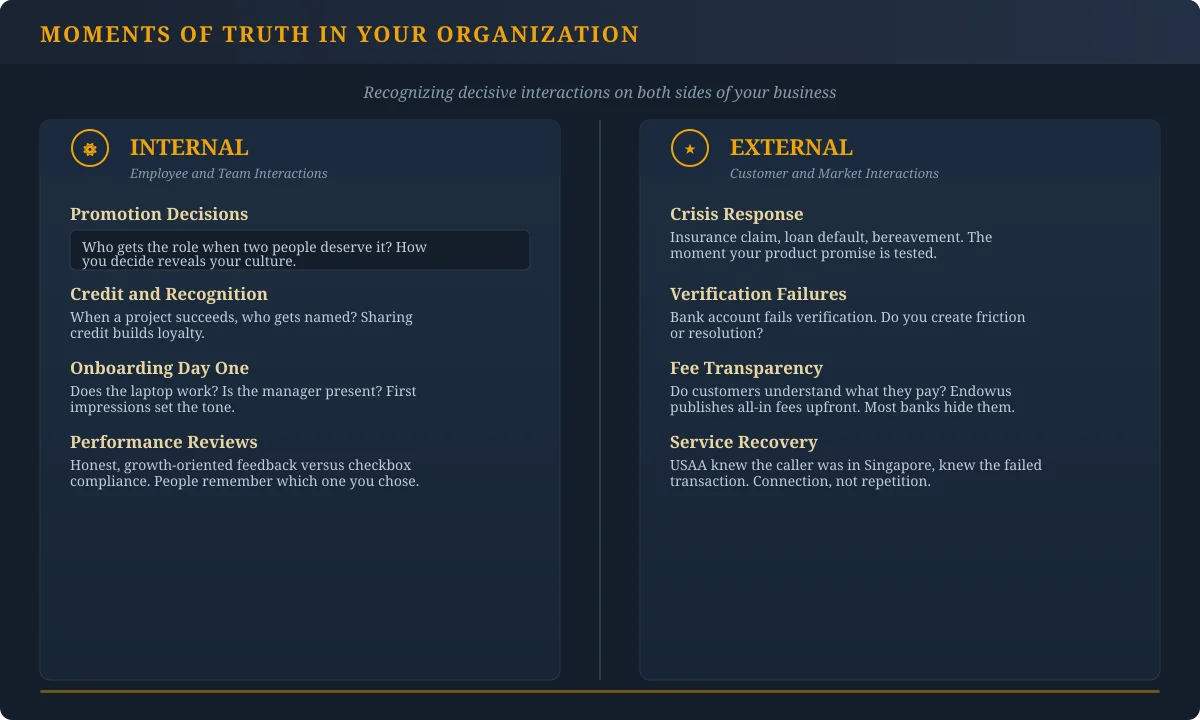
These decisive interactions exist on both sides of your business. Recognizing them is the first step toward managing them.
Internal Moments of Truth
Internal moments shape culture and employee experience, which directly drive external service quality.
- Promotion Decisions. Who gets the role when two people deserve it? How you decide reveals your culture more than any values statement.
- Credit and Recognition. When a project succeeds, who gets named? Sharing credit builds loyalty. Hoarding it builds resentment.
- Onboarding Day One. Does the laptop work? Is the manager present? First impressions set the tone for years of employment.
- Performance Reviews. Honest, growth-oriented feedback versus checkbox compliance. People remember which one you chose.
External Moments of Truth
External moments determine customer lifetime value and brand reputation.
- Crisis Response. Insurance claims, loan defaults, bereavement. The moment your product promise is tested most severely.
- Verification Failures. A bank account fails verification. Do you create friction or resolution? The answer defines your brand.
- Fee Transparency. Do customers understand what they pay? Most banks hide fees in layers of complexity. Transparency is a competitive weapon.
- Service Recovery. When something goes wrong, does context travel with the customer, or does every interaction start from zero?
USAA: The Gold Standard for Moments of Truth
USAA, the United Services Automobile Association founded in 1922, maintains a 96% customer retention rate and a Net Promoter Score of 83. The banking industry average NPS is 18. USAA's scores exceed Amazon e-commerce and Apple iPhone satisfaction benchmarks.
These numbers are the result of deliberate investment in employee experience, customer data infrastructure, and a culture that treats every interaction as a moment of truth.
The Singapore Call
I was in Singapore when I received news that my father had passed away in New York. I needed to close bank accounts and arrange a funeral from 10,000 miles away. I called several banks: Citibank, JPMorgan, and USAA.
Citibank and JPMorgan processed the account closure requests efficiently. USAA did something different.
"Mr. Carter, thanks for being a long 15-year customer and we'll certainly help you close your dad's accounts. By the way, we noticed you're calling from Singapore. How are you going to handle the funeral arrangements?"
USAA then offered a list of recommended funeral parlors and went further: regardless of which funeral parlor was chosen, USAA would pay the bill directly on my behalf, eliminating the need for international wire transfers during a time of grief.
This was not a private wealth account. I had approximately $4,000 in a standard retail banking account.
The Connected Experience
The same customer later had trouble completing a transaction on the USAA website. When he called customer service, the representative immediately said: "Sir, were you having trouble with this transaction on the website?"
I did not have to explain the problem. The authenticated web session and the authenticated phone call were connected. Context traveled with the customer.
What Made This Possible
Six months later, I called back to ask how this experience was possible. USAA's explanation revealed three foundational investments:
- Extensive staff training. Employees are trained to handle the human context behind transactions, not just the transactions themselves.
- 360-degree customer view. Systems provide a complete picture of the customer across all products and channels on one screen.
- Employee experience drives customer experience. When employees can access information quickly and act with authority, they respond to human needs, not just transactional requests.
| Metric | USAA | Banking Industry Average |
|---|---|---|
| Customer Retention | 96% | ~75-85% |
| Net Promoter Score | 83 | 18 |
| Benchmark Comparison | Higher than Amazon, higher than Apple | Far below cross-industry leaders |
The formula: better employee experience delivers better customer experience, which delivers higher service quality, higher satisfaction, increased sales, higher profit, greater shareholder returns, and higher retention and loyalty.
Customer 360: Powering the Moment of Truth
A Customer 360 is a single, unified view that provides real-time, cross-product visibility into who the customer is and what they need at any given moment. It connects four critical data streams:
- Customer Profile. Family composition, life stage, financial goals, relationship history.
- Transaction History. Products held, recent activity, alerts, and account status across all lines of business.
- Service Interactions. Call history, web sessions, chat transcripts, social media contacts, and omnichannel touchpoints.
- Next Best Action. AI-driven recommendations for proactive offers, cross-sell opportunities, and service recovery based on all available context.
The Transformation Customer 360 Enables
| Dimension | Without Customer 360 | With Customer 360 |
|---|---|---|
| Systems | Siloed. Insurance cannot see banking. Each call starts from zero. | Unified. One screen shows everything. |
| Customer Effort | Every agent asks the same questions. The customer connects departments. | Context travels with the customer. Immediate resolution. |
| Personalization | No context means no personalization. The customer is a ticket number. | AI surfaces next best actions based on life stage and goals. |
| Proactivity | A family with teenage children never gets offered a college savings plan. | Funeral arrangements offered before asked. Anticipation, not reaction. |
Customer 360 gives your employees the data they need to deliver at the moment of truth. Without it, even the best-trained employee cannot respond to the full human context. With it, every interaction can be personalized, proactive, and meaningful. This is where AI-powered systems in financial services become essential infrastructure, not optional tooling.
Samuel Rhee and Endowus: Radical Generosity in Action
Samuel Rhee spent 30+ years in institutional investing, rising to CEO and Chief Investment Officer at Morgan Stanley Investment Management Asia, overseeing $40B+ in assets under management. His career trajectory illustrates how moments of truth at the personal level create outsized long-term returns.
The Promotion Moment of Truth
After the 2009 Financial Crisis, Samuel and a colleague were both in the running for promotion to CEO/CIO of the Asia business. Both had strong cases. Their boss flew from New York to Singapore with an announcement: only one promotion had been secured. Rather than deciding himself, he told both candidates to discuss and decide who would go first.
Samuel chose to step aside. He told his colleague to go first.
The colleague's response was unexpected. Rather than relief, the mood was somber. The colleague recognized that what Samuel had done, voluntarily surrendering a deserved promotion, was something he could not replicate. That colleague became one of Samuel's biggest supporters. Samuel eventually became CEO and CIO at Morgan Stanley Investment Management Asia.
Surrendering a right you have earned is not weakness. It is a strategic act that creates lasting advocates and builds a leadership reputation no promotion could provide.
The Pivot to Endowus
At the peak of his career, Samuel identified a fundamental gap: institutional investors had access to high-quality research, excellent products, and low costs. Retail investors paid high fees for poor service and product-pushing.
In 2017, Samuel left Morgan Stanley to found Endowus, a digital wealth platform that democratizes institutional-grade investing for everyone. The operating principle: the customer's economic gain must be much bigger than what they pay.
The Generosity Flywheel
The counterintuitive result of radical generosity is sustainable competitive advantage. Each stage feeds the next, creating compounding momentum that competitors using traditional extraction models cannot replicate.
- Lower margins build higher trust
- Higher trust attracts more clients
- More clients create greater scale
- Greater scale reduces costs
- Lower costs enable even better value
- Better value locks in sustainable advantage
Traditional Model vs. Endowus Model
| Dimension | Traditional Financial Services | Endowus (Radical Generosity) |
|---|---|---|
| Fee Structure | High fees: 2-4% all-in | Low fees: 0.65-1.10% all-in |
| Platform Take | Maximize revenue per customer | Platform takes just 0.05-0.6% |
| Pricing | Opaque. Hidden layers of charges. | Transparent. All-in fee published upfront. |
| Philosophy | Product-pushing. Sell what earns the most. | Advice-first. Recommend what serves the client best. |
| Core Objective | Maximize what clients pay the firm. | Maximize what clients gain relative to what they pay. |
The results: $5B+ AUM, Asia's largest independent digital wealth platform, first digital advisor authorized for Singapore CPF investing, and backed by UBS, Prosus, EDBI, Lightspeed, Citi, MUFG, Samsung, and Singtel.
The Pattern Across Cases
| Who | What They Gave Up | What They Gained |
|---|---|---|
| Samuel Rhee | A promotion he deserved | A career-long advocate, then became CEO |
| Endowus | High margins (2-4% to 0.65-1.10%) | $5B+ AUM, Asia's largest independent platform |
| USAA | Short-term efficiency | 96% retention, NPS of 83, lifetime customers |
Applying the KDA Framework
The Know-Decide-Act framework provides a structured approach to operationalizing moments of truth across your organization.
Know. Map your top three moments of truth. Where does your product promise get tested most severely? Audit your Customer 360 capability. Can your front-line employees see the full picture when they pick up the phone? Identify the gap between your marketing promise and your operational delivery.
Decide. Choose where you will invest in radical generosity. Review your fee structures, pricing models, and service tiers. Determine whether the customer's economic gain is larger than what they pay. Decide which internal moments of truth, promotions, credit sharing, onboarding, need redesign.
Act. Build the infrastructure. Deploy Customer 360 capabilities that connect data across products and channels. Train employees to handle human context, not just transactions. Measure moments of truth with metrics that matter: NPS, retention, customer effort scores. The AI Masterclass Series and Agentic AI for Financial Services programs provide the operational frameworks for executing this transformation.
The question every financial services leader must answer: are you extracting value from customers, or creating it? The organizations that choose creation, consistently, under pressure, are the ones that build $5B platforms and 96% retention rates.
The Strategic Imperative
Financial services operates in an environment where trust is the primary currency. Every interaction either deposits trust or withdraws it. The moment of truth is where that accounting becomes visible.
Customer 360 is the infrastructure. Radical generosity is the strategy. The generosity flywheel is the mechanism. Together, they create competitive advantage that extraction-based competitors cannot replicate at scale.
The leaders who understand this are not just building better customer experiences. They are building organizations that compound trust over decades. In an industry where switching costs are declining and transparency is increasing, that compounding effect is the only sustainable moat.
Your next moment of truth is coming. The only question is whether your organization is built to deliver on its promise when it matters most.
Want to put this into practice?
Keith works with leadership teams across Asia and globally to turn AI insight into action. Reach out directly — response within 24 hours.